Most dental practices treat claim denials as the primary threat to their bottom line. But the real damage often comes from somewhere less obvious: approved dental claims that simply pay less than they should.
Why Underpaid Dental Claims Are a Bigger Problem Than Denials
When a dental claim gets denied, your team notices. There’s a zero-dollar payment, a rejection reason, and a clear action item. But when a claim is approved and a check arrives, most practices post the payment and move on. No one questions a payment that looks routine.
That’s where the problem hides. Underpaid claims are approved claims where the insurance company reimburses less than the contracted or expected amount. The payment appears normal on the explanation of benefits, but the allowed amount, write-off, or patient responsibility calculation is slightly off. Maybe the payer applied the wrong fee schedule. Maybe a secondary payment was never pursued. Maybe a small balance was written off to avoid a phone call. Each instance might only cost $10 or $40, but across hundreds of claims per month, those discrepancies compound into serious losses.
Consider a 3-doctor dental practice in Texas producing $3 million per year. If just 4% of collections are lost to underpaid dental claims, that’s roughly $120,000 in annual revenue that quietly disappears, separate from any denied claims. Industry data suggests that many practices lose between 3% and 10% of annual collections through billing inefficiencies and underpayments, with some estimates showing 10-15% of gross production never collected despite services being delivered.
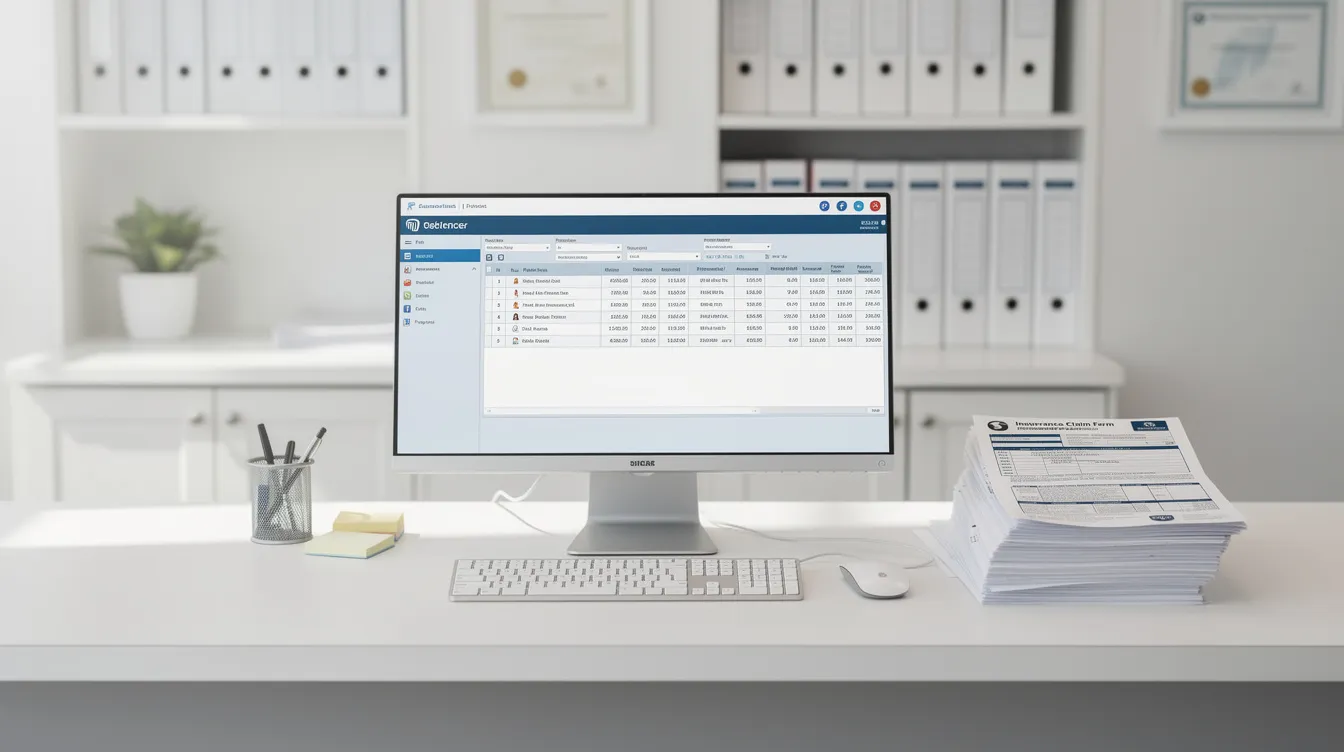
At Prospa Billing, we see this pattern constantly when onboarding new practice partners. During initial EOB audits, we routinely recover missed revenue that the practice assumed was already collected correctly. The underpayments come from three high-level culprits that we’ll unpack in the sections ahead: incorrect plan fee schedules, systematic write-off habits, and a lack of structured EOB review on approved claims.
How a Dental Claim Is Supposed to Pay Out (So You Can Spot Underpayments)
Before you can spot what’s wrong, you need to understand what “right” looks like.
A dental claim is a formal request for payment for dental services rendered. The standard flow starts when dental procedures are performed at the dental office. The treating dentist or billing team then prepares and submits the claim, which includes services received and costs, to the patient’s insurance. The dental claims process includes the collection of insurance information and payment details before submission.
A clean claim form requires accurate patient information, subscriber details, the provider’s national provider identifier, tax identification number, correct CDT codes (the standardized codes used to identify specific dental treatments), tooth number and surface data where applicable, and the practice’s billed fee for each procedure code. Dentists must code and document services accurately for insurance claims to process correctly.
Once submitted, the insurance company verifies coverage during the review and processing of a claim. The dental insurance plan reprices the provider’s billed fee using its contracted fee schedule, then calculates the allowed amount, the contractual write-off, and the patient’s share. Insurance payment can be sent direct to the dental office or used to reimburse the patient, depending on assignment of benefits.
Here’s how this plays out with numbers. Suppose a dentist submits a crown (CDT code D2740) billed at $1,400. The contracted allowed amount with that dental plan is $1,050. Many dental insurance plans have a coverage structure of 100/80/50, meaning preventive care typically has 100% coverage under basic dental plans, basic restorative is covered at 80%, and major services like crowns are covered at 50%. Assuming the patient has met their deductible, the math looks like this:
- Billed fee: $1,400
- Allowed amount: $1,050
- Contractual write-off: $350 ($1,400 minus $1,050)
- Insurance pays: $525 (50% of $1,050)
- Patient responsibility: $525
That’s what the explanation of benefits should show. But if the insurer pays only $475 instead of $525, that $50 shortfall may be buried in the allowed or adjustment lines and never questioned. When any piece of this calculation-fee schedule, coverage percentage, frequency limits, waiting periods-is misapplied, the claim still pays, just less than it should.
Understanding this ideal calculation is the foundation for recognizing underpayments in real-world EOBs.
Common Ways Dental Insurance Plans Underpay: Fee-Schedule Mismatches
Fee-schedule errors are one of the most common and least visible causes of lost revenue in dental practices. They rarely trigger a denial or a flag. They just quietly reduce what you collect on every affected claim.
Dental PPO plans maintain multiple fee schedules. A single carrier might have separate schedules for Premier versus PPO networks, state-specific variations, and employer-specific plan configurations. When a patient is adjudicated against the wrong schedule, the allowed amount shifts-sometimes by $10, sometimes by $80-and the practice absorbs the difference as a write-off without realizing it.
A concrete example: in 2025, some practices in Ohio in-network with Delta Dental found that posterior composites (CDT codes D2391 through D2394) were still being reimbursed at fee levels set in 2022. The payer had never attached the updated schedule to the employer’s group. Every composite filling for patients on that plan was underpaid, and the practice had no idea until an audit surfaced the pattern.
This kind of mismatch also happens when new associate providers join, when a practice opens a new location, or when tax ID changes occur during credentialing. If the payer’s system doesn’t link the new provider or entity correctly, claims may process at out-of-network rates or on a generic schedule instead of the contracted one. Frequency of service issues can further complicate things, leading to claim rejections or reduced payments when the payer’s system misinterprets plan limitations.
To catch these problems, compare your top 20 high-volume procedure codes’ allowed amounts on recent EOBs against the current contracted fee schedule stored in your practice management software. Do this for each major payer. Repeated $8 to $20 underpayments on high-volume CDT codes over 12 to 24 months can easily total tens of thousands in lost collections.
Write-Off Habits That Quietly Turn Underpayments Into “Policy”
Even when a payer underpays, many practices never discover the problem because their own billing habits bury it. Front desk and billing teams often normalize small discrepancies as “the insurance adjustment.” Over time, insurer mistakes become permanent write-offs that nobody questions.
Here are the patterns we see most often:
- Automatically zeroing patient balances under $25 to avoid phone calls or patient complaints
- Writing off differences when patients push back, without verifying whether the insurance payment was actually correct
- Coding discretionary discounts as “insurance adjustment” instead of “courtesy discount,” making it impossible to separate contractual obligations from voluntary losses
The numbers add up fast. A dental practice that writes off $15 on each of 30 hygiene visits per week loses over $23,000 in hygiene revenue alone across a year (30 visits × 52 weeks × $15). One practice profiled by Dental Economics lost $110,000 in a single year because staff routinely wrote off variances without reconciling EOBs against contracted fee schedules.
The root issue is often a lack of clear adjustment codes and policies in the practice management system. When every write-off is lumped under one generic category, there’s no way to distinguish legitimate contractual adjustments from preventable revenue leakage.
Prospa Billing’s approach is to standardize adjustment types from day one: separating PPO contractual write-offs from discretionary discounts and flagging unusual patterns in monthly AR reports. Disciplined write-off rules protect both the practice’s profitability and the team from making ad-hoc decisions under patient pressure. Your dental professionals deserve clarity, not guesswork, when it comes to what gets written off and why.

The Case for Routine EOB Audits: Not Just for Denials
An explanation of benefits EOB is the document insurers return to show how they processed a particular claim. It details insurance payments and patient responsibility for each service. Most dental office teams use EOBs to post payments and then file them away. Very few use them to verify whether the payment was actually correct.
That’s a missed opportunity. Payers make system changes, employers change dental benefits mid-year, and plan documents are interpreted inconsistently across claims. Filing claims accurately can improve reimbursement speed, but even perfectly submitted claims can be underpaid if the payer’s system misapplies rules. Regular audits can uncover missed revenue opportunities that would otherwise go unnoticed for months or years.
You should always file your claim as soon as possible after treatment, since claims may be denied if filed after the timely filing deadline. Timely filing deadlines vary by insurer and plan, so tracking them is essential. But even claims filed on time and paid promptly deserve scrutiny.
Here’s a simple monthly workflow. For each major payer, sample 20 to 30 paid claims across different procedure types. For each audited claim, verify the correct CDT code and tooth or quadrant, confirm the correct provider NPI and tax identification number are linked to the payer contract, compare the allowed amount to the current fee schedule, check that the write-off matches the contractual adjustment, and confirm patient responsibility was calculated correctly per coinsurance and deductible rules.
This audit should focus on approved claims, not just denied ones, because most underpayments hide in the “Paid” column. One audit of 2,399 dental claims at a single practice found $59,000 in underpaid claims-27% of claims audited were underpaid.
As an outsourced billing partner, Prospa Billing systematically audits EOBs and pursues corrected claims and appeals when underpayments are identified. This isn’t a one-time project; it’s a continuous process built into our service model.
What to Look For on a Dental Claim Form and EOB
The dental claim form is what goes out to the payer. The explanation of benefits is what comes back. Errors in either can lead to underpayments-not just denials. Accurate billing prevents claim denials and delays, and accurate claim paperwork reduces denials and delays as well.
On the Claim Form
The ADA dental claim form includes information about the patient and provider details. Key fields include patient information, subscriber ID, group number, the treating dentist’s national provider identifier, provider and pay-to addresses, CDT codes, tooth numbers, and billed fees. Identification and contact information are required from patients during claims processing, and patients must provide accurate policy details for benefit verification.
Common claim mistakes include typos and incorrect billing codes. A wrong NPI, outdated address, or incorrect coordination-of-benefits details involving a primary carrier and other insurance can cause the payer system to apply the wrong contract or pay at out-of-network rates. Claims can be denied for out-of-date personal information, so keep records current for both new patients and existing ones. Patients may need to submit claims themselves for out-of-network providers, which introduces additional room for error.
About 14% of dental claims are still submitted via paper, which increases the risk of data entry errors compared to electronic submission. Whether you use a paper claim or electronic submission, the same accuracy requirements apply.
On the EOB
Every EOB breaks down the submitted amount, allowed amount, write-off or adjustment, insurance paid, patient responsibility, and reason codes. Watch for reason codes that indicate downgrades, frequency limits, annual maximums, or missing tooth clauses. Pay special attention when the allowed amount is lower than expected with no explanation.
For example, an EOB for a D2740 crown might show an expected allowed amount of $840, but the payer only allows $762. That $78 variance could be written off as “normal” if staff don’t compare it against the contract.
This can happen when an in-network provider is inadvertently paid at an out-of-network allowed amount because the NPI wasn’t correctly linked in the payer’s system. Accurate data on the claim form, paired with careful EOB review, reduces both claim rejections and hidden underpayments. It’s one of the common reasons practices lose money without realizing it.
Using Pre-Treatment Estimates to Prevent Future Underpayments
A pre treatment estimate is a proactive way to confirm dental benefits and allowed amounts before major dental procedures are scheduled. When a dentist submits a pre-authorization request, the insurer responds with relevant information about how the particular treatment will be adjudicated-what will be allowed, what limitations apply, and whether coverage applies at all.
While pre-treatment estimates are not a guarantee of payment, they reveal plan limitations that would otherwise surprise you after the fact. These include annual maximums, frequency restrictions, waiting periods, and whether a procedure will be downgraded (for example, a composite paid at amalgam rate). Claims can be denied if the treatment is not covered, and a pre-authorization request will flag that before you schedule the patient.
For example, suppose you submit a pre treatment estimate for a $1,000 crown. The insurer responds that the dental benefits plan will only allow $850, will apply a missing tooth clause, and coverage is at 50%. Now you can set patient expectations accurately and discuss whether they’re financially responsible for the difference. Without that estimate, the patient may be surprised by the balance, and the practice may absorb costs through courtesy write-offs.
Use pre-treatment estimates selectively-prioritize higher-value treatment plans (cases over $2,000, implants, multi-unit bridges, orthodontic care) rather than every routine visit. For most dental plans, preventive covered services like cleanings and x rays don’t require pre-authorization. But for major work, estimates are a powerful tool.
Prospa Billing helps practices build clear internal workflows so that front desk, clinical, and billing teams all have access to pre-treatment estimate data when discussing finances with patients. And critically, we compare the final EOB to the original estimate to catch payer underpayments or incorrect application of plan rules after the fact.

Building a System to Catch Underpayments in Your Dental Practice
Catching underpaid dental claims isn’t a one-time cleanup. It’s a repeatable process that needs structure, accountability, and the right tools.
Start with written adjustment policies that define what constitutes a legitimate contractual write-off versus a discretionary discount. Set audit targets-for example, review 10% of monthly claims per payer-and assign a specific team member responsibility for reviewing EOBs and flagging discrepancies. Chart notes and supporting documentation should be accessible to anyone reviewing a particular claim.
Leverage your practice management software to generate reports by adjustment type, by provider, and by payer. These reports help you spot abnormal trends: Is one payer consistently paying less on periodontal scaling and root planing codes? Is a specific provider’s claims always processed at lower rates? Are certain other procedures routinely underpaid? Automated billing tools can improve collections efficiency and streamline workflows by surfacing these patterns faster than manual review.
Practices can choose between building an in-house billing team with audit responsibilities or partnering with an outsourced dental revenue cycle management company like Prospa Billing. Many dental practices find that the expertise and bandwidth required for systematic audits exceeds what their in-house team can manage alongside patient care, submitting claims, handling duplicate radiographs requests, and managing health plans verification.
Prospa Billing provides end-to-end claim management-from eligibility verification and insurance claim submission to payment posting, denial and underpayment appeals, and monthly AR aging analysis. High-performing practices target a net collection rate above 95% and a denial rate below 5%. When your numbers fall short, underpayments and unworked denials are almost always to blame.
Once the system is in place, the goal is predictable, optimized revenue from dental benefits-not surprise write-offs and quiet leakage. You stop saving money by ignoring small variances and start saving money by catching them.
When to Bring in an Outsourced Dental Billing Partner Like Prospa Billing
Several pain points signal it’s time to consider outsourcing. If your aging AR is climbing past 60 days, if patients are frequently confused by unexpected balances, or if your staff spends more time on the phone with payers than with patients, those are clear indicators. Licensed dentists and dental professionals should be focused on clinical care, not chasing down a $30 underpayment on a paper copies request.
A specialized dental billing and revenue cycle partner like Prospa Billing provides expert dental insurance claims processing, dedicated EOB auditing, denial and underpayment appeals, payment posting, and patient billing support. We integrate with common dental practice management systems in the U.S. and maintain strict HIPAA and data security compliance. Whether you need to submit a claim, document additional information for an appeal, or contact a payer about a particular claim, our team handles it.
As an example, a 4-operatory practice that partnered with Prospa Billing reduced its 90-plus-day AR by 40% in six months. The primary driver wasn’t chasing denials-it was systematically scrubbing paid claims, identifying underpayments, and recovering revenue the practice had already written off.
Denied claims are obvious. Underpaid, “approved” claims are the ones that cost you the most-and they’re exactly what Prospa Billing is built to catch.
If you’re not sure how much revenue is hiding in your EOBs, request a no-obligation review of your last 60 to 90 days of dental claims and payment data. You may find that the process of recovering what’s already yours pays for itself many times over. Your social security number and patient details remain protected under our HIPAA-compliant protocols, so you can focus on what matters: delivering great care while your reimbursement stays where it belongs.
0 Comments