Getting paid for the clinical work you deliver should be straightforward, but most dental practices in today’s insurance-heavy market know it rarely is. Between payer rules that shift quarterly, CDT code updates every October, and patients who expect flexible payment options, the billing side of dentistry has become a specialty in its own right.
Dental billing is the process of submitting and following up on claims for payment for dental services provided to patients. The dental billing process includes workflows used to collect from both insurance companies and patients. Mastering dentist billing is at the core of maintaining steady cash flow, reducing administrative stress, and ensuring compliance with evolving insurance regulations.
Dental practices need a thorough understanding of insurance plans, government programs such as Medicaid or CHIP, and billing regulations to ensure accurate and timely payment for their services. This guide breaks down exactly how dentist billing works in 2026, where revenue leaks happen, and how to fix them. It is intended for dental practice owners, office managers, and billing staff seeking to improve their billing processes and financial outcomes
The goal of dental billing is to maximize the practice’s revenue while ensuring compliance with applicable laws and regulations. Dental billing is a team effort involving the clinical team, the doctor, and the dental administrator to successfully collect payments from insurance companies.
What is dentist billing and why does it matter in 2026?
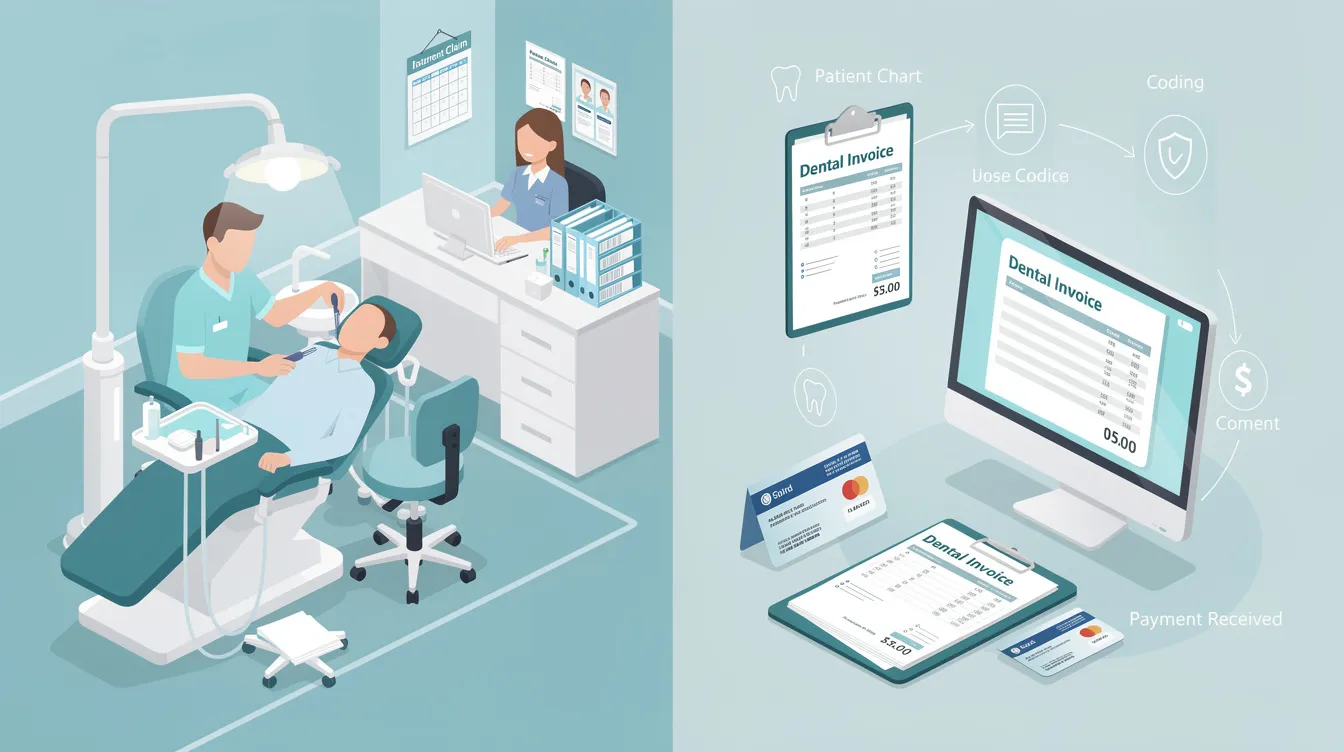
Dental billing is the process of submitting and following up on claims for payment for dental services provided to patients. The dental billing process includes workflows used to collect from both insurance companies and patients. Verification of insurance coverage, deductibles, and maximums occurs before treatment. Insurance verification is the first step in the insurance billing process and is crucial to ensuring timely payments and minimizing claim denials. The dental insurance billing process involves creating, submitting, following up, and collecting payment from insurance claims. Dental billing encompasses every aspect of sending the completed treatment to an insurance carrier for reimbursement per the patient’s insurance plan.
Dental billing is the complete end-to-end process of converting the dental care you provide into actual cash in your bank account. It includes everything from verifying a patient’s dental plan before they sit in the chair to chasing down the last $50 of a patient balance three months later.
In practical terms, it covers two major payment streams: collecting from insurance companies and collecting from patients pay directly.
In 2026, most dental practices rely on a mix of preferred provider organization (PPO) plans, fee-for-service arrangements for uninsured patients, and occasional crossovers to medical insurance for procedures like oral surgery billing and coding, sleep apnea appliances, and trauma-related dental treatment. PPO plans cover roughly 70-80% of insured patients, which means navigating payer-specific rules is the core of your revenue cycle.
This matters because dentist billing directly determines your practice’s financial health. The U.S. dental services market was valued at $192.22 billion in 2023, and efficient billing practices are what separate thriving practices from those constantly scrambling to cover payroll. When billing breaks down, so does consistent cash flow.
The pain points are real and getting worse. Claim denial rates average 10-15% across dental claims, with projections for increases due to stricter payer audits. Many dental offices see 20-30% of their accounts receivable aging past 60 days. Add in frequent CDT code changes (the ADA added over 50 new codes in 2025 alone), understaffed front desks, and ever-shifting payer rules on frequencies and limitations, and you have a recipe for lost revenue.
For a typical two-doctor practice, billing errors can mean $50,000 to $100,000 in annual lost revenue. That comes straight out of owner take-home income after write-offs, which often exceed 5-10% of gross production without robust denial management.
Prospa Billing exists to solve this problem. As a U.S.-based dental billing and revenue cycle management partner, we handle verification, coding, claim submission, and follow-up through outsourced medical and dental billing services so your in-office team can focus on chairside patient care instead of fighting with insurance providers.
How does the dentist billing process work from appointment to payment?
The dental billing process is a sequential workflow that starts before your patient arrives and ends only when their balance hits zero. Each step depends on the one before it, which is why a breakdown anywhere in the chain stalls cash flow for weeks or months.
Here is how the revenue cycle unfolds in a well-run dental office:
- First, registration captures patient demographics, insurance information, and subscriber details during scheduling. For a new patient exam and full-mouth series (FMX) scheduled for April 3, 2026, your front desk must record the primary and secondary insurance, employer details, and relationship to subscriber accurately.
- Next is insurance verification, which is the first step in the insurance billing process and is needed to ensuring timely payments and minimizing claim denials. This step happens 48-72 hours before the appointment to confirm coverage for specific CDT codes, check frequency limits (one FMX per five years under many PPOs), and note deductibles and annual maximums.
- Third, treatment planning and fee presentation follow, where you provide written financial estimates based on verified benefits and collect signed agreements outlining patient responsibility for copays, coinsurance, and non covered services.
- Fourth, coding occurs after treatment. Dentists document their work using Current Dental Terminology (CDT) codes, assigning precise codes like D0210 for FMX or D2391 for resin-based composite, along with tooth numbers, surfaces, and provider NPI. Accurate documentation and coding of all services provided is needed to ensure proper reimbursement and avoid claim rejections.
- Fifth, submitting claims happens within 24-48 hours via electronic data interchange to clearinghouses, including required attachments such as radiographs or perio charts. Submitting claims accurately and promptly is critical for timely reimbursement from insurance companies.
- Sixth, payment posting reconciles the explanation of benefits (EOB) with your practice management software, applying adjustments per contracted fee schedules.
- Seventh, denial management tracks rejection reasons via aging reports and initiates appeals within payer deadlines. Finally, patient billing sends statements for remaining balances and escalates to collections if overdue beyond 60-90 days.
Common breakdowns include incorrect subscriber IDs at registration (causing 40% of denials), missing documentation like perio charting for scaling and root planing, narratives not included for complex procedures, and missed timely filing deadlines.
Maintaining thorough and accurate records helps master the dental billing process and ensure timely reimbursement. Standardized operating procedures for each step reduce variation between team members and locations, cutting AR days from 45-60 to under 30 in optimized practices.
What is the dental insurance billing process in a typical practice?
Dental insurance billing is the creation, electronic submission, and persistent follow-up of insurance claims to PPO, HMO, Medicaid, government programs such as Medicaid or CHIP, and select medical payers for covered services. Practices should aim to understand and effectively manage claims related to government programs for accurate billing and proper reimbursement, as these programs have unique requirements. This process typically generates 60-70% of practice revenue in PPO-heavy markets, making accuracy non-negotiable.
Insurance verification is foundational and is the first step in the insurance billing process. Before treatment, you must confirm the patient’s dental coverage including plan type, in network providers status, frequencies (such as two cleanings per year), downgrades (porcelain crown billed as amalgam), waiting periods, and annual maximums. Real-time verification through payer portals or clearinghouses prevents surprises that inflate patient collections later.
A complete dental claim requires ADA-standard elements: accurate CDT codes with appropriate modifiers, tooth and surface information, provider and group NPI, tax ID, correct payer ID, and required attachments. The dental provider must be properly credentialed and recognized by insurance carriers to facilitate claims submission and reimbursement.
For restorations, you typically need bitewing X-rays. For scaling and root planing (D4341/D4342), payers require full-mouth probing charts showing pockets greater than 5mm plus supporting radiographs, reinforcing the importance of accurate dental billing and coding practices.
Consider two common scenarios:
- A D2740 porcelain crown claim may be denied or downgraded without a narrative justifying medical necessity over a metal crown.
- An SRP claim submitted without 6-point perio charting and radiographs faces a 15-20% denial rate.
Both situations delay insurance payments and create administrative rework.
Most clean electronic claims process within 7-21 days via ERA 835 files. Balances lingering past 30-45 days need active follow-up. Persistent issues require formal appeals with enhanced documentation. Payers like Delta Dental typically allow 60 days for appeal submissions.
Prospa Billing monitors aging reports weekly, chases unpaid claims, and prepares appeal packets with clinical notes, narratives, and supporting documentation as part of our outsourced dental insurance billing services. Our approach reduces denial rates by 20-30% through dual human review of complex claims.
How does patient billing work, and what makes it different from insurance billing?
Patient billing covers everything related to collecting the patient’s financial responsibility: copays, deductibles, coinsurance, non covered services like cosmetic whitening, and payment plans for larger cases. Unlike the rigid, code-driven rules of the insurance billing process, patient billing is relationship-driven and directly affects patient satisfaction and retention.
Involving dental assistants in patient education and communication help patients understand billing, treatment options, and payment plans, which builds trust and improves satisfaction. Educating the entire dental staff about billing processes can enhance the patient experience and lead to better collections.
Financial transparency is a core aspect of proper patient billing. Before treatment, you should provide written estimates detailing verified patient portions. A signed financial agreement clarifies late fees, payment expectations, and what happens if insurance pays less than expected. When the explanation of benefits arrives showing the insurance pays 60% instead of the expected 70%, a reconciliation statement explains the $200 shortfall clearly.
In 2026, a patient-friendly billing experience includes text and email statements via portals like Dentrix Ascend, online payments with Apple Pay or Google Pay, card-on-file for automatic charges, recurring plans for orthodontics, and third-party financing through services like CareCredit for procedures performed exceeding $2,000, often supported by specialized patient billing and statements services. Collecting 80-90% of estimated patient portions at the time of service dramatically reduces AR.
Let’s look at an example: for implant surgery (D6010) with a $4,000 total fee and $1,200 patient share, you collect payment at the time of surgery rather than billing afterward. If the EOB later shows an underpayment, you send an explanation letter with the adjusted balance rather than a surprise bill.
Prospa Billing integrates with common systems like Dentrix, Eaglesoft, and Open Dental to automate statement generation, and our patient billing and statement services reduce overdue patient balances by 25-40% through consistent, timely communication.
What are the most common dentist billing mistakes, and how do you avoid them?
Small billing errors compound into serious revenue losses. A typical two-doctor practice loses $30,000 to $75,000 annually from a 10% denial rate alone. Understanding where these mistakes happen is the first step toward preventing them.
Skipping or rushing insurance verification causes roughly 40% of all denied claims:
- Using incorrect CDT codes (like billing D2391 when D2392 applies for multi-surface composites) triggers downgrades and rejections.
- Running outdated fee schedules that ignore annual PPO updates (typically 5-10% hikes) means you under-collect from day one.
- Failing to attach required documentation like perio charts causes 25% of SRP claim denials. Neglecting AR over 60 days allows timely filing windows to close.
- Sloppy payment posting that mismatches ERAs creates phantom balances.
Real examples can illustrate the stakes. An SRP claim (D4341) denied for absent 6-point perio charts requires rework and resubmission, if the timely filing deadline has not passed. A composite downgraded without the proper contract adjustment means you either absorb the loss or bill the patient a delta you may not legally collect, depending on your participation agreement.
Prevention strategies are straightforward. Use check-in checklists that verify eligibility and subscriber ID before every appointment. Conduct quarterly coding audits cross-referencing current ADA CDT manuals. Sync fee schedules with payer portals regularly. Run daily clearinghouse rejection scans. Build AR dashboards that flag claims over 90 days before timely filing expires.
Compliance risks add another layer. Upcoding (billing surgical extraction D7210 for simple D7140), unbundling certain procedures, or billing for services rendered that lack documentation can trigger payer audits and potential accusations of fraud under the False Claims Act, with penalties up to $11,000 per claim, which is why periodic billing performance and risk assessments are so valuable.
Prospa Billing uses standardized workflows, dual review on complex claims, and analytics dashboards to catch 90% of errors before submission.
What is dental coding and compliance?
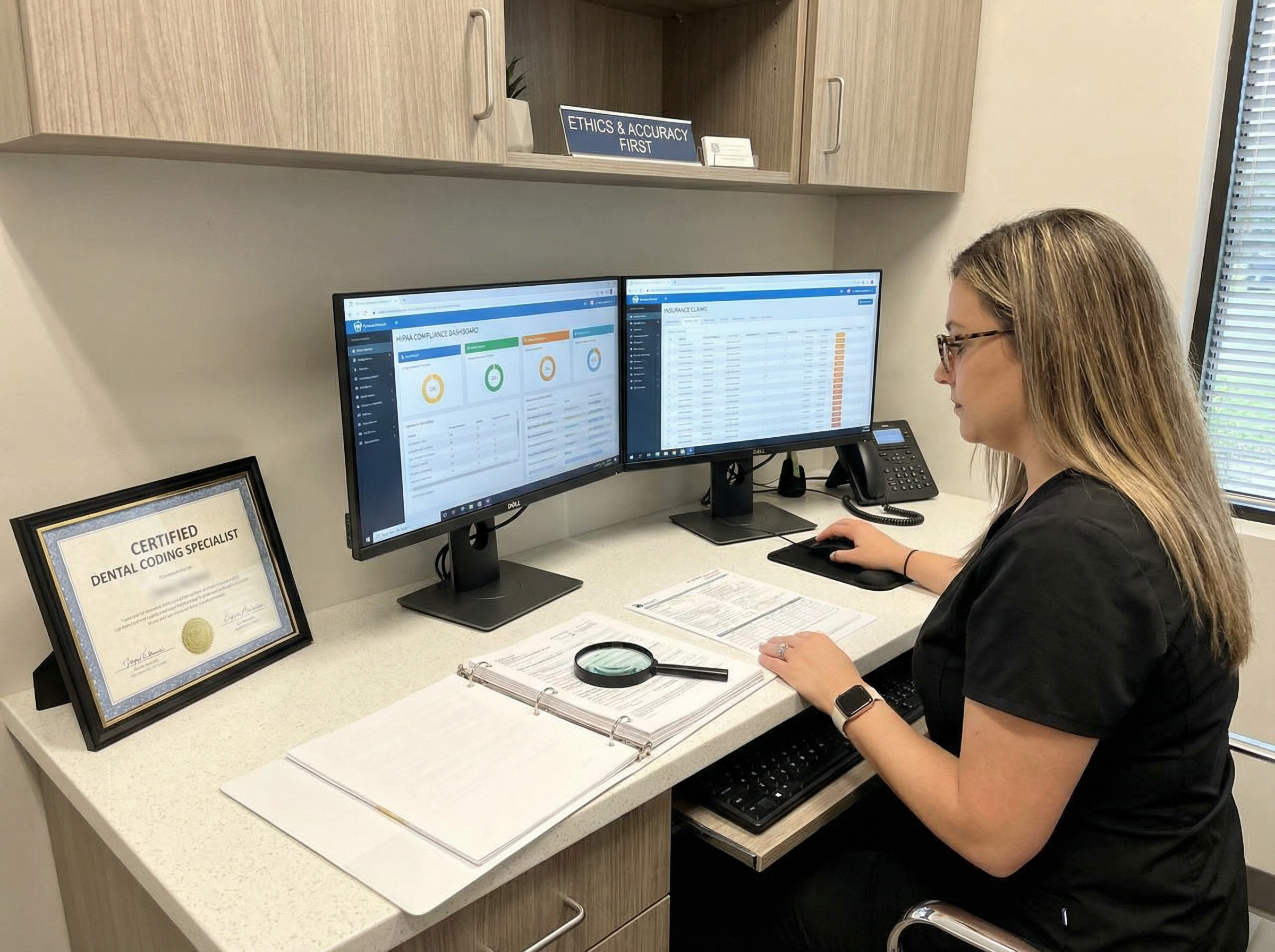
Accurate dental coding and strict compliance are the backbone of a successful dental billing process. For dental practices, getting coding right means ensuring every service provided is billed correctly, maximizing reimbursement and minimizing the risk of claim denials, and resources that focus on understanding dental billing and coding can support this effort.
Staying current with the latest CDT codes and insurance billing regulations is a priority, as even minor errors can lead to costly delays or rejected claims.
Investing in robust practice management software helps automate and standardize the coding process, reducing human error and streamlining the workflow.
Regular staff training is equally important. Keeping your team updated on code changes and compliance requirements ensures your billing process remains efficient and effective. This proactive approach not only supports smoother revenue cycle management but also protects your practice from compliance pitfalls that can threaten financial stability.
By prioritizing dental coding accuracy and regulatory compliance, dental practices can reduce denied claims, accelerate payments, and maintain a healthy revenue cycle. Ultimately, this attention to detail safeguards your financial health and allows you to focus on delivering quality patient care.
How can patient financing and payment plans make care affordable and boosts collections?
Offering patient financing and flexible payment plans is a must-have for dental practices aiming to improve both patient satisfaction and collections. Many dental offices now provide a range of payment options, from in-house financing to partnerships with third-party providers, making dental care more accessible for patients facing out-of-pocket costs.
Flexible payment options not only help patients manage their dental expenses but also lead to higher acceptance of recommended treatment plans. This approach reduces the risk of unpaid balances and supports a steady cash flow for your practice. Clear communication about available payment plans and financing options builds trust, empowering patients to make informed decisions about their dental care.
By making it easier for patients to afford necessary dental services, practices can boost patient satisfaction, increase loyalty, and see a measurable improvement in collections. Prioritizing transparent, patient-friendly payment options is a win-win for both your patients and your bottom line.
How do dental billing security and compliance protect patient data and your practice?
With the increasing reliance on digital systems in dental billing, security and compliance have never been more important. Dental practices must implement strong data protection measures such as encryption, secure servers, and regular security audits to safeguard sensitive patient information and maintain compliance with regulations like HIPAA.
Ongoing staff training on data handling and security protocols will prevent breaches and ensure everyone understands their role in protecting patient confidentiality. By prioritizing dental billing security and compliance, and partnering with an expert dental billing team dedicated to accuracy and protection, practices not only avoid costly penalties and reputational damage but also reinforce patient trust.
Maintaining secure and compliant billing practices is fundamental to the long-term financial stability of your dental office. By staying vigilant and proactive, you protect both your patients and your practice from unnecessary risk.
How is dentist billing changing with AI, automation, and outsourcing?
From 2024 through 2026, AI adoption in healthcare billing accelerated rapidly. Industry reports suggest automation now handles 40-60% of repetitive dental billing tasks, and many practices are evaluating outsourcing dental billing to specialized partners, driven by post-pandemic staffing shortages and rising denial rates that demand faster, more accurate responses.
Practical automation applications include:
- real-time eligibility checks via API pulls,
- automated claim status inquiries,
- flagging missing attachments before submission,
- CDT code suggestions based on NLP-parsed clinical notes (with human verification),
- and AR prioritization sorted by denial codes and dollar amounts.
These tools reduce manual entry errors by approximately 70% while freeing dental billers to focus on complex cases requiring judgment.
AI augments experienced billers rather than replacing them. A system might flag that “deep pockets” in a clinical note suggests D4341, but a human coder verifies the diagnosis codes, confirms documentation completeness, and adds the narrative that gets the claim paid.
Outsourcing involves HIPAA-secure remote access under Business Associate Agreements. Specialists mirror your practice policies in your existing practice management software, maintaining workflow consistency while reducing your administrative burden.
Common owner concerns have clear answers. Is outsourcing secure? Yes—reputable partners use encrypted VPNs and maintain SOC2 compliance. Will you lose control? No—custom dashboards show AR aging, denial trends, and claim status in real time. How do you see what is happening? Weekly reports benchmark your performance against peers, with top-quartile practices maintaining AR under 35 days.
Prospa Billing combines specialized dental billers with standardized workflows and technology, cutting AR over 90 days by 50% and freeing in-office staff from 10-15 hours of administrative work weekly.
What are best practices for dentist billing that boost profitability?
Profitable dentist billing comes from consistency and measurement, not one-time fixes. The practices that collect the most and write off the least track specific metrics monthly and adjust based on data.
Key metrics to monitor include:
- days sales outstanding (ideally under 40),
- percentage of AR over 60 days (target under 15-20%) and over 90 days (under 5%),
- collection ratio (above 98%),
- denial rate (below 5%),
- and average time from date of service to payment (under 21 days).
Build a dashboard that surfaces these numbers weekly.
Process best practices drive results. Verify benefits 48-72 hours before every appointment. Collect estimated patient portions on the day of service (this single change can boost collections by 30%). Submit claims within 24 hours of treatment. Review denial trends monthly to identify patterns like frequency limit rejections or pre authorization requirements.
Staff training for 2026 should cover CDT code updates (released annually in October with approximately 40 changes), coordination of benefits sequencing, medical billing crossovers for certain procedures like sleep appliances, and scripts for communicating financial expectations. Example: “Your estimated $250 copay is due today.”
Quarterly internal audits ensure clinical notes support the medical codes and procedures billed. This prevents 80% of potentially appealable denials and protects against audit risk.
Prospa Billing provides monthly AR reports, denial analysis, and benchmark data showing how your financial performance compares to similar practices, enabling data-driven adjustments that yield 10-15% profitability improvements.
How do patient billing, insurance verification, and claims management fit together?
These three areas are not separate silos but interconnected components of one revenue cycle. An error in verification ripples through to inaccurate patient estimates and preventable claim denials.
Accurate insurance verification is the foundation. When you confirm remaining annual maximums, waiting periods, and network status before treatment, you enable both clean claims and precise patient estimates. If you miss that a patient’s $1,500 maximum has only $200 remaining, you will either face a surprise denial or send a $700 patient bill that damages trust.
Effective claims management includes:
- prompt submission within 24 hours,
- daily clearinghouse rejection checks,
- timely appeals (most payers allow 30-60 days),
- and escalation of unresolved claims before filing deadlines expire (typically 90-365 days depending on the insurance plan).
Aligned patient billing closes the loop. When insurance posts, the remaining balance is communicated clearly through convenient channels (text, email, or portal) with flexible payment options that make collection easy rather than adversarial.
When all three processes work together, practices see lower overdue AR, fewer write-offs, and more predictable monthly cash flow. When they operate as silos, 25% revenue leakage becomes normal.
Prospa Billing offers integrated support across verification, claims, and AR follow-up, eliminating the chaos of juggling multiple vendors for different pieces of the billing process.
What are best practices for dental billing and patient satisfaction?
A seamless dental billing process is a key driver of patient satisfaction and loyalty. Dental practices that provide clear, transparent billing information and offer flexible payment options make it easier for patients to understand and manage their financial responsibilities. Timely payments and straightforward communication reduce confusion and stress, leading to a more positive patient experience.
Investing in patient education about billing and payment options empowers patients to take an active role in their care, fostering trust and long-term relationships. Regularly reviewing and refining your billing process ensures it remains patient-centric and responsive to evolving needs.
By making dental billing as smooth and transparent as possible, practices can enhance patient satisfaction, encourage repeat visits, and build a reputation for excellent service.
How does dental billing and staff productivity empower your team?
Efficient dental billing processes are key for maximizing staff productivity and allowing your team to focus on what matters most: patient care. By leveraging practice management software and streamlining administrative workflows, dental practices can significantly reduce the time and effort required for billing tasks.
Providing ongoing training and support ensures staff are confident and capable in handling the billing process, leading to fewer errors and faster turnaround times. Empowered team members are more engaged, experience higher job satisfaction, and are less likely to experience burnout or turnover.
Prioritizing staff productivity through better dental billing not only improves your practice’s operational performance but also creates a more positive work environment. When your team is equipped to manage billing effectively, your entire practice benefits from increased efficiency and long-term success.
How can Prospa Billing help your practice collect more and stress less?
Prospa Billing serves as a dedicated dental billing and revenue cycle management partner for independent U.S. practices and small groups, and our mission and background as a specialized dental billing company guide every client engagement. We handle the administrative work that steals time from patient care and drains financial stability through comprehensive medical and dental billing outsourcing solutions.
Our services cover the complete billing cycle:
- pre-visit insurance verification,
- claim creation and submission,
- payment posting,
- denial and appeal management,
- patient billing support,
- and AR clean-up projects for practices with backlogged balances.
Typical client results include a 40-60% reduction in AR over 90 days and collection rates improving from 95% to 99%. These outcomes translate directly to improved financial performance and reduced staff burnout.
Onboarding takes 2-4 weeks and includes integration with your existing practice management software, BAA setup for HIPAA compliance, and a complete AR audit to identify immediate revenue recovery opportunities. You maintain visibility through transparent dashboards showing real-time claim status and aging trends.
Ready to stop leaving money on the table? Contact Prospa Billing for a discovery call to review your current AR aging report and identify revenue leaks costing your practice thousands annually.
Frequently Asked Questions about Dentist Billing
How long should it take for my dental claims to get paid?
Clean electronic claims typically receive reimbursement within 7-21 days. Paper claims and those requiring manual review extend to 45 days or longer. If a balance persists beyond 30 days, follow up through payer portals immediately.
What percentage of my AR should be over 60 days?
Ideally, less than 15-20% of your total accounts receivable should exceed 60 days, with AR over 90 days staying below 5%. Higher percentages signal workflow gaps costing you the equivalent of 1-2% monthly in lost collection opportunity.
When should I consider outsourcing dentist billing?
Consider outsourcing when your AR days exceed 45, denial rates climb above 10%, or administrative tasks consume more than 20% of staff time. ROI typically materializes at $50,000 or more in monthly production.
Can I bill dental procedures to medical insurance?
Yes, for medically necessary procedures like trauma extractions, sleep apnea appliances, and TMJ treatment. These require appropriate diagnosis codes and coordination with dental coverage after primary medical processing.
How often do CDT codes change?
The ADA updates CDT codes annually in October, typically adding 30-50 new codes. Additionally, insurance providers update their policies and fee schedules quarterly. Contact Prospa Billing for a tailored analysis of how these changes affect your specific payer mix.


0 Comments