This dental billing cheat sheet gives your team a printable, task-oriented reference for handling CDT codes, CPT codes, cross-coding scenarios, and clean claim submission in 2026. Stop guessing, start billing faster.
Quick-start: how to use this dental billing cheat sheet
This guide is built for front-desk, clinical, and billing staff at independent U.S. dental practices. If your team juggles cdt codes daily, occasionally dips into medical codes, and deals with frequent insurance claims denials, this is your quick reference.
The structure is simple: key definitions first, then common cdt codes by category, cross-coding tips for when dental insurance won’t cover a procedure, a step-by-step dental billing process checklist, and denial fixes. Using a cheat sheet prevents coding guesswork in dental billing and keeps everyone aligned.
At Prospa Billing, we use similar internal cheat sheets to cut AR days and claim denials for our clients. All content here reflects 2026 updates, including the CDT 2026 changes that introduced 31 new codes, 14 revisions, and 6 deletions effective January 1, 2026. Always verify payer-specific rules before submitting.
Dental billing vs. conventional medical billing: at-a-glance
Dental billing differs from conventional medical billing in three fundamental ways: the code sets, the benefit structures, and the claim forms. Here are the key contrasts:
- Dental billing primarily uses CDT codes (d codes starting with “D” plus four digits) on the ada dental claim form. Medical billing relies on CPT and ICD-10 codes submitted on CMS-1500 or UB-04 forms.
- Dental insurance typically has a $1,500 annual maximum per patient. Medical insurance uses high deductibles and coinsurance with no fixed annual cap for covered conditions.
- Dental plans impose strict frequency limitations (cleanings twice yearly, X-rays every 1–2 years). Medical plans focus on medical necessity thresholds.
Where conventional medical billing concepts still apply: insurance verification, prior authorization, ICD-10-CM diagnosis support, denial management, and payment posting all work the same way.
Quick examples of when to think “medical biller” vs. “dental biller”:
- Routine prophy (D1110) → always dental, always CDT
- Jaw fracture treatment → likely medical, using CPT codes with ICD-10 diagnosis S02.6x series
- Sleep-apnea oral appliance → medical insurance with HCPCS E0486 and ICD-10-CM G47.33
Core terminology: must-know dental billing terms and abbreviations
Mastering basic dental terminology is the first step to accurate coding and faster claim submission. Post this near every billing station.
| Term | Definition |
|---|---|
| CDT (current dental terminology) | ADA-maintained five-character procedure codes for dental services |
| CPT | AMA-maintained medical procedure codes for broader healthcare services |
| ICD-10-CM | Diagnosis codes explaining the medical necessity of treatments |
| ADA Dental Claim Form | Standard dental claim form for submitting dental claims |
| EOB | Explanation of Benefits from the insurer |
| ERA | Electronic Remittance Advice for automated payment posting |
| PPO / HMO | Preferred Provider Organization / Health Maintenance Organization plan types |
| Preauthorization | Insurer approval obtained before certain dental procedures |
| COB | Coordination of Benefits for patients with multiple insurance plans |
Clinical abbreviations you will see on superbills: FMS/FMX (intraoral complete series or full mouth radiographs), SRP (periodontal scaling and root planing), RCT (root canal therapy), PFM (porcelain fused to metal crown).
Misunderstanding COB leads to duplicate billing denials. Missing ICD-10 codes triggers medical necessity denials. These terms tie directly into denial management.

CDT codes cheat sheet: common D-codes every team should know
This is a high-level guide to common cdt codes, not a replacement for the ADA CDT 2026 manual. CDT codes are maintained by the american dental association and the ADA CDT code book updates annually with new codes and revisions. CDT codes start with “D” followed by four digits. CDT coding is essential for accurate dental insurance claims.
Common dental procedure codes are used for restorations and specialty services across these categories:
- Diagnostics (D0100–D0999): D0120 (periodic oral evaluation, established patient), D0140 (limited oral evaluation, problem-focused), D0150 (comprehensive oral evaluation)
- Preventive (D1000–D1999): D1110 (adult cleaning/prophy – common cdt codes like D1110 for adult cleaning appear on nearly every schedule), D1120 (child prophy), D1206 (topical fluoride)
- Restorative (D2000–D2999): D2391 (one surface posterior composite – note the 2026 descriptor change), D2740 (porcelain/ceramic crown)
- Endodontics (D3000–D3999): D3310 (anterior tooth root canal), D3320 (premolar RCT), D3330 (molar RCT)
- Periodontics (D4000–D4999): D4341 (SRP, four or more teeth per quadrant, requires perio charting and radiographs), D4910 (periodontal maintenance)
- Prosthodontics (D5000–D5899): D2750, D6240, D6750 for fixed partial denture work
- Oral surgery (D7000–D7999): D7140 (simple extraction), D7210 (surgical removal of erupted tooth, bone removal may be involved)
- Implants (D6000–D6199): D6010 (endosteal implant placement), D6058 (abutment care)
Reading CDT code ranges helps your team group standardized codes on internal cheat sheets, reducing re-keying errors and speeding up accurate coding during live calls.
When CDT isn’t enough: CPT codes and ICD-10-CM in dental billing
Your dental billing cheat must include CPT guidance because certain dental procedures require medical billing. Medical billing relies on cpt codes and ICD-10 codes when dental coding alone won’t satisfy payer rules. CPT codes apply to dental procedures with medical necessity – trauma, pathology, systemic disease.
Key distinctions:
- CDT codes → dental insurers, dental benefit plans
- CPT codes → medical payers when the procedure has a dental diagnosis tied to systemic or traumatic conditions
- You cannot mix CDT and CPT on the same claim form
CPT examples relevant to dentistry: maxillofacial surgery fracture repair codes, sleep-apnea appliance procedures (HCPCS E0486), and oral pathology biopsies. ICD-10-CM diagnosis codes explain the medical necessity of treatments. Common dental diagnosis codes include K02.9 (dental caries), K05.3 (chronic periodontitis), G47.63 (sleep-related bruxism), and S02.6x (mandible fractures).
Accurate coding requires verifying that each code matches the appropriate ICD-10-CM diagnosis. Use payer bulletins and crosswalks rather than guessing.
Dental-to-medical cross-coding: high-yield scenarios and shortcuts
Cross-coding means tracking performed services under a CDT code internally while submitting a corresponding CPT code and ICD-10 to medical insurance for eligible cases. Detailed clinical notes support medical necessity in every scenario.
Most common cross-coding scenarios for your billing cheat sheets:
- Trauma: Motor vehicle or sports injuries → confirm medical necessity, gather radiographs, submit CPT with injury diagnosis
- Biopsies / oral pathology: Suspicious lesions → CPT biopsy codes with ICD-10 neoplasm codes
- Sleep apnea appliances: Custom oral devices → HCPCS E0486 with G47.33, file medical first
- TMJ disorders: Severe pain with imaging evidence → CPT codes for procedure documentation
- Hospital-based oral surgery: Revenue codes (e.g., 0360 for OR services), CMS-1500 and UB-04 may both apply
For each scenario: confirm payer criteria, gather documentation (photos, radiographs, narratives), select matching CPT and ICD-10, and decide whether to submit medical before dental. Prospa Billing routinely builds cross-coding mini cheat sheets by procedure type for clients. You can create similar one-page job aids for your top five crossover procedures.
Step-by-step dental billing process (2026 fast-reference checklist)
Follow this checklist as your daily dental billing process workflow:
- Insurance verification: Verify patient insurance 48 hours before appointments. Automated eligibility checks can reduce manual billing errors. Check frequency limitations and remaining annual maximums.
- Prior authorization: Claims may require pre-authorization for extensive dental work like crowns, implants, or general anesthesia sedation cases.
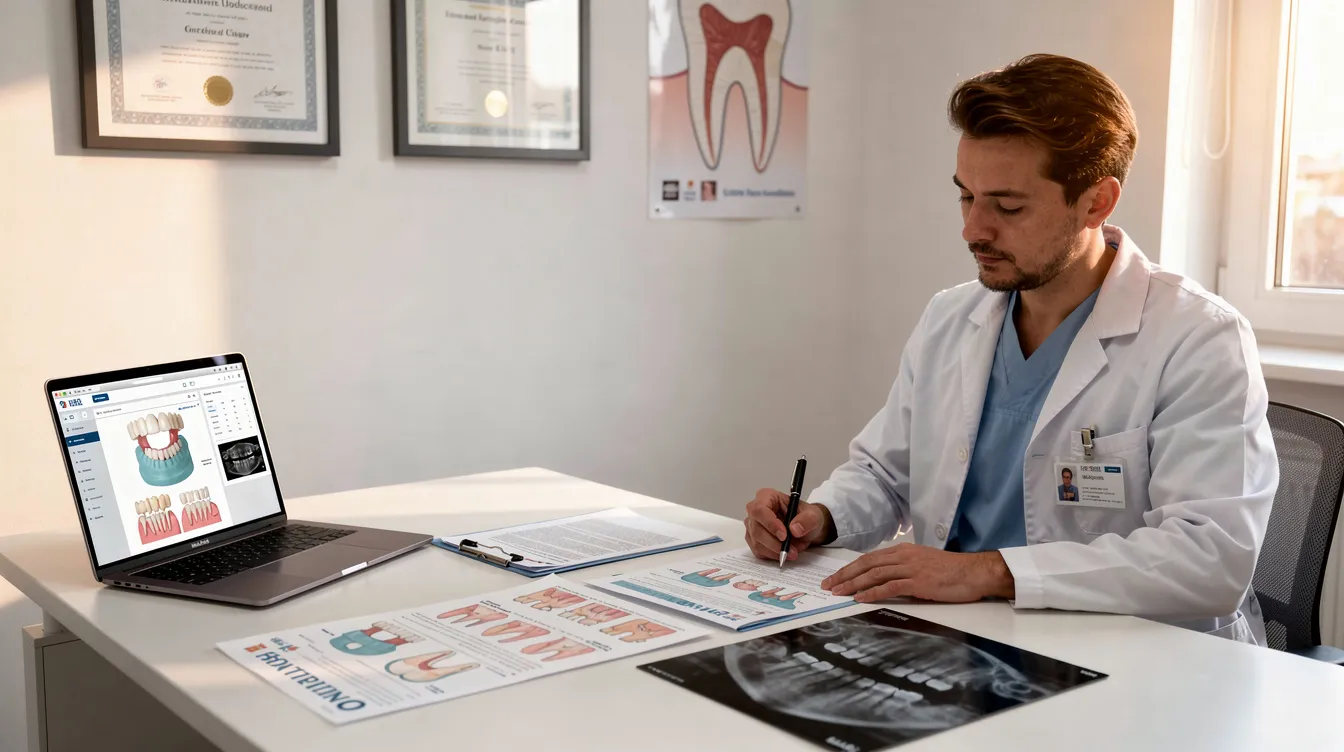
- Clinical documentation: Post-procedure, capture tooth numbers, surfaces, narratives, and radiographs. Documentation must meet the american dental association guidelines.
- Superbill creation: Enter CDT codes immediately. For cross-coded cases, include CPT and ICD-10. This is where treatment planning meets accurate coding.
- Claim submission: Use ADA Dental Claim Form for dental claims. Claims should be submitted within 24-48 hours after treatment. Attach required documentation with dental claims.
- Claim tracking: Track claim status regularly after submission. Regular claims tracking reduces accounts receivable days significantly. Communicate claim status and follow up on unpaid claims over 30 days.
- Payment posting: Post payments against patient ledgers upon receipt. Utilize Electronic Remittance Advice to automate payment posting.
- Patient billing: Collect patient deductibles and co-pays at the time of service to improve cash flow. Educating patients on financial responsibility can minimize collection issues. Patient responsibility should be clear before services provided.
- Denial follow-up: Address denials within 48 hours. Monitor insurance aging reports weekly to follow up on outstanding claims.
- Reporting: Review AR aging, denial categories, and payer performance monthly for record keeping and internal audits.
Denial management cheat sheet: common challenges and quick fixes
Denial management is crucial; missing codes cause 40% of claim denials. Accurate coding prevents 40% of claim denials, making a denial cheat sheet essential at every billing workstation. In 2026, 78% of dental offices reported an uptick in claim denials or increased payer scrutiny.
| Denial Reason | Quick Fix |
|---|---|
| Outdated/missing CDT codes | Use the latest CDT codes to prevent automated denials; update software |
| Missing documentation | Attach required documentation to dental claims to avoid denials (X-rays, perio charts, narratives) |
| Benefit maximum reached | Verify remaining max before service; alert patient |
| Frequency limitation | Check frequency limitations with payer before scheduling |
| Missing ICD-10 on medical claim | Add dental diagnosis code; include clinical narrative |
| COB errors | Verify primary insurer; collect subscriber data |
| Non-covered / unlisted procedure | Review policy pre-treatment; obtain patient consent |
Denial management should address issues within 48 hours. Track claims regularly to expedite appeals and reduce AR days. Track denials by category monthly and update your internal cheat sheets when patterns emerge.
Prospa Billing uses denial analytics dashboards to eliminate repeat denials. Practices can replicate this with reports from their practice management software. Top performers maintain first-pass denial rates under 5%, while average practices sit at 8–12%.
Practical billing shortcuts and templates that save time
These are essential dental billing shortcuts and insider shortcuts focused on saving biller time while maintaining compliance – not coding rules.
- Dental billing shortcuts include ready-to-use templates and scripts: standard narratives for crowns, implants, SRP, and medical-necessity statements. Keep ready to use templates for eligibility verification calls and secure email/fax for sending X-rays.
- Batch claim submissions weekly to improve cash flow. Set a daily submission window rather than submitting ad hoc.
- Use payer web portals instead of phone calls for eligibility and claim status. Keep separate payer-specific cheat sheets noting each top payer’s quirks.
- Avoid common challenges like upcoding or unbundling. These are revenue boosters that backfire – they trigger audits and recapture. Every shortcut must ensure compliance with CDT definitions and payer policies.
This comprehensive package of shortcuts works as high-level bullet ideas your team can customize for your practice size and coding services specialty.
Creating and maintaining your in-office dental billing cheat sheets
A static cheat sheet becomes outdated fast. The ADA CDT code book updates annually with new codes, and payer policies shift mid-year. You need a simple process for regular training and updates.
- Designate a “cheat sheet owner” (lead biller or office manager)
- Schedule annual reviews in Q4 timed to CDT and CPT release cycles; update when payers issue new policies
- Organize by topic: common CDT codes, payer rules, cross-coding, denial reasons
- Store in printed binders and shared digital folders
- Never include PHI on cheat sheets; keep payer contact lists current and HIPAA-compliant
Practices who feel overwhelmed can partner with Prospa Billing to implement standardized, practice-specific cheat sheets as part of an outsourced revenue cycle setup.
Should you practice outsource dental billing to experts like Prospa Billing?
As dental coding and payer rules grow more complex, many dental practices turn to specialized partners. Here is why:
- In-house: Ongoing salary costs, CDT/CPT training, turnover risk, vacation coverage gaps
- Outsourced: Specialist knowledge, current code updates, dashboard tools for AR metrics, expert denial management
Outsourcing dental billing can increase revenue by 15-25%. Practices typically see reduced AR days, fewer write-offs, higher clean-claim rates, and more clinician time focused on patient care.
Prospa Billing integrates with common dental practice management systems for claim submission and payment posting, keeping your workflow seamless without switching platforms.
Schedule a brief revenue review where Prospa Billing walks through your current claims data and suggests specific cheat sheet improvements tailored to your payer mix.
FAQ: fast answers for everyday dental billing questions
Does dental billing use CPT or CDT codes? Use CDT codes for services billed to dental insurers. Use CPT codes when the procedure meets medical necessity and goes to medical insurance. Never mix both on the same dental claim form.
What is the best way to stay current with CDT code changes each year? Subscribe to ADA Code Maintenance Committee updates. Audit your practice management software before January 1 each year. Check your top payers’ handbooks for insurance billing guides on new code coverage.
When should I bill a dental procedure to medical insurance? When the procedure is triggered by trauma, pathology, congenital conditions, or systemic disease. File the medical claim first, then dental if needed. Always include ICD-10-CM diagnosis codes.
What are the 4 main parts of dental billing workflow? Insurance verification, coding and procedure documentation, claim submission, and payment posting with denial management. Enforce timelines: verification 48 hours before, claims within 24 hours, denials addressed within 48 hours.
How fast should we follow up on unpaid claims? Track weekly. If no response after 30 days, escalate. AR days target under 30. AR over 90 days should be under 15% of total AR.
Where can I find accurate dental coding references? Official sources: ADA CDT manual, AMA CPT code book, payer policy portals, and Prospa Billing’s resource library. Avoid relying solely on informal internet lists or outdated cdt coding guide documents.
What role does dentistry play in medical cross-coding? Dentistry intersects with medical when services address systemic conditions. Your team should maintain crosswalks mapping dental procedures to CPT equivalents for your most common scenarios.
Print these cheat sheets, review them in monthly staff huddles, and update them as codes, payers, and practice goals evolve. Your billing team – and your cash flow – will thank you.


0 Comments